


Todd Rundgren Creates Music for the Love of the Uncommon Ear
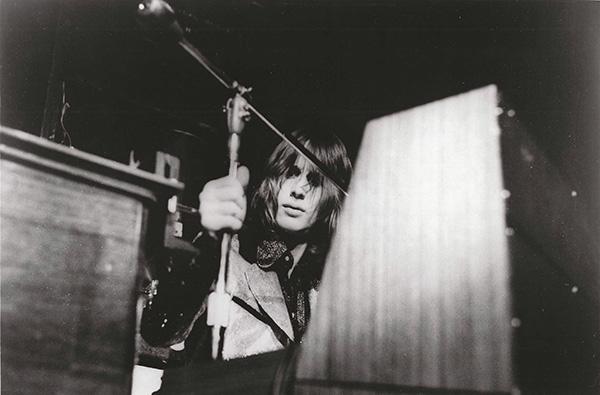
If anything, Todd Rundgren embodies the title of his 2018 autobiography, for he is, without a doubt, The Individualist through and through. In addition to producing a vast catalog of original material that is arguably at its best when heard on vinyl, Rundgren is also an inveterate road warrior — and he’s back at it again this summer with the perfectly named “Damned If I Do” tour, which got underway last week on June 11, 2026.
“Sometimes you are damned if you do, because the audience already has a certain version of a song imprinted in their head — and that’s what they expect to hear,” Rundgren told me from his new home in Kaua’i, Hawaii, during a recent Zoom interview. “But I have about four different versions of ‘Hello It’s Me,’ depending on what I think I can get away with,” he continued, in reference to one of his most recognizable and well-loved songs that you’ll definitely hear in one variation or another at some point during this tour’s 27-song set.
(Speaking of said show — for all the tour dates and ticketing info, go here. Rundgren’s top-shelf “Damned If I Do” band includes longtime bandmates bassist Kasim Sulton and drummer Prairie Prince in addition to keyboardist Gil Assayas, guitarist Bruce McDaniel, and horns master Bobby Strickland.)
In Part 1 of our interview that appears over on our recently revived sister site Sound & Vision, Rundgren and I discussed the “Damned If I Do” summer tour, mixing music in Atmos, and the joys and pitfalls of mixing for vinyl — and you can read that piece right here. In Part 2 of our chat that’s exclusive to AP, Rundgren, 77, and I talk about the first record he ever bought that still permeates his music-making DNA to this day, some truly cool 45s from his own back catalog, and what he feels his top priority is as a producer. It’s important to me / That you know you are free. . .

Mike Mettler: Back when you were growing up, what was the first record you can remember buying that I call “The Talisman Record” — the one you bought that you really felt like, “This is my thing. I have to get this one myself, and go home and play it.” Do you have one of those?
Todd Rundgren: Well, the first record that I bought, and (looks around), I don’t know, it may possibly be in this room somewhere (chuckles) — it followed me for most of my life — was actually a weird compilation record called Boppin’! It was pre-Beatles. Eventually, I did buy a Beatles record, but this was before The Beatles. I don’t know why I bought that particular record except for the fact that it was, like, 69 cents — so I could afford it! (chuckles again) [Boppin’! was released in 1960 on Jubilee.]
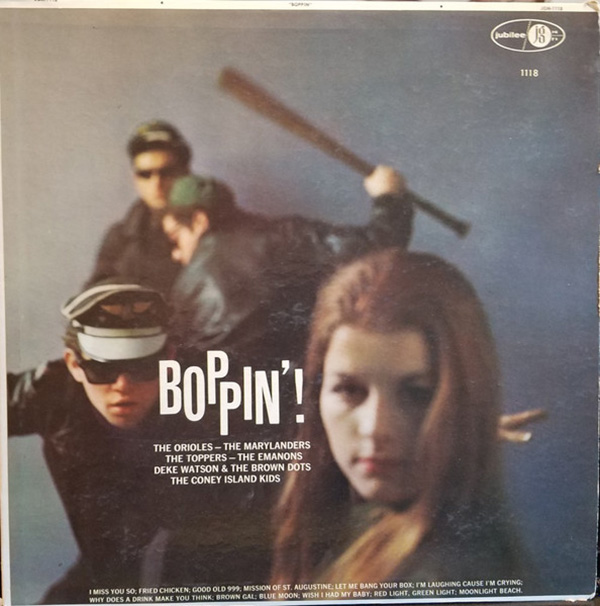
Rundgren: It was definitely cut-out material. It was a weird collection of non-hits; things that you’d never heard by all kinds of different, weird artists — collections of American teens who were singing (Todd sings,) “Can I kiss your cherry lips? / Red light! / Just one kiss, you’ll never miss / Red light!” You know? Weird little novelty songs. (chuckles) [The lines he just sang there are from The Coney Island Kids’ “Red Light, Green Light” (Side 1, Track 3).]
Deke Watson & Brown Dots (sings again), “Why do a drink make you think / I could care for you?” [from “Why Does a Drink Make You Think” (Side 2, Track 5)]. I remember almost every single song on the record.
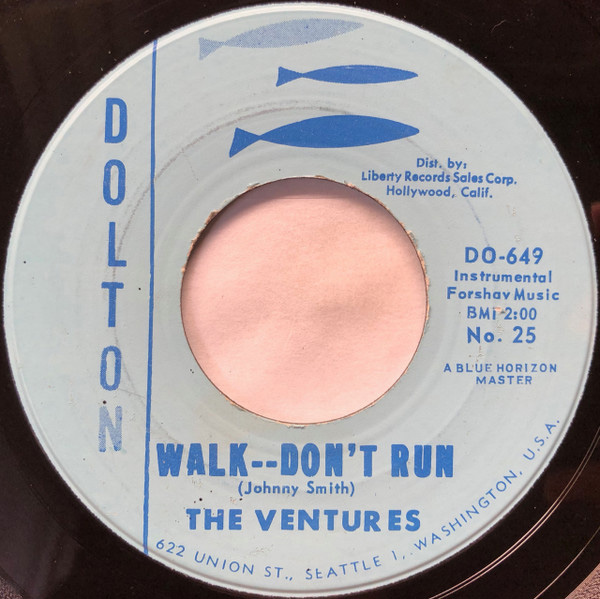
Rundgren: So, that was the first album I bought. I must have bought a single before that — and if I did, it might have been something like “Walk, Don’t Run” by The Ventures, because that’s what inspired me to wanna play guitar. So, I might have owned that single. [The Ventures’ seminal instrumental version of Johnny Smith’s “Walk, Don’t Run” was released on Dolton in the spring of 1960, and it peaked at No. 2 on the Billboard 100 singles chart.]
Mettler: When my parents moved many years ago, they gave me all the original 45s of theirs they still had from the ’50s and ’60s — stuff like Elvis on RCA, Chuck Berry on Chess, The Beatles, The Stones, and so many others — and I love playing them every now and then. There’s just something about — I mean, there’s a tactile connection to all this stuff, isn’t there?
Rundgren: Yeah. My first record player was this RCA thing — and it only played 45s, because it had the big thick spindle on it. You could put a stack of them on it, and it would play all through the stack — and then you’d flip the stack over. But nowadays, you need a box full of spiders [i.e., 45 adapters] if you’re gonna play those 45s, you know?

Mettler: Oh, I’ve got those. I’ve got a bunch of those! (both laugh)
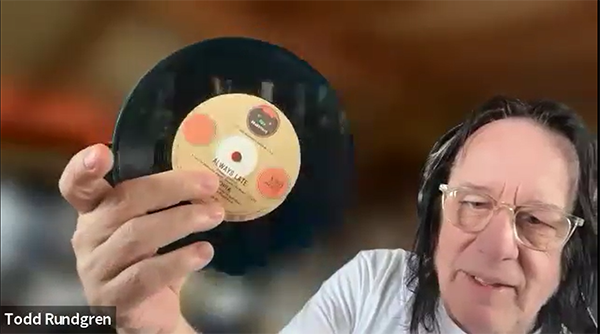
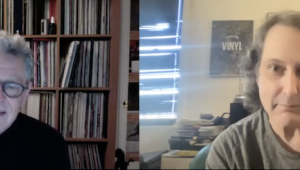
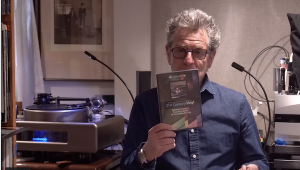
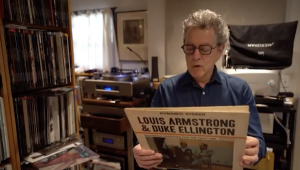
Rundgren: I moved into what is essentially a new studio since I moved to Kaua’i [in Hawaii]. We built a house, and I have a new room in it. I’m so far behind that I haven’t even unpacked most of the vinyl. It’s all still in boxes somewhere. I imagine someday I will have a lot of spare time and I’ll be bored, and then I will (pauses) . . . oh, I just saw this! Look at this. I don’t know why it’s sitting over here. [Todd picks up a Bearsville 45 of his December 1972 single, “Hello It’s Me,” and holds it up to the Zoom camera, as seen above; it’s the Australian version (BSV-0009).]
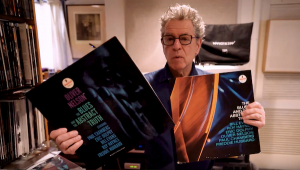
And it has the tiny hole in it, see? I know that the big spindle doesn’t exist anymore. [Rundgren picks up another 45.] And here’s a Utopia single too — “I Just Want to Touch You,” which was from [September 1980’s] Deface the Music. I don’t know if you can see it because of the light source, but it’s blue vinyl. [Todd flips it over to show the B-side, “Always Late,” as seen below; this is also the Australian version (K 8074).]
Mettler: Man, I love seeing those, because they’re two classic 45s of yours! Since we’re talking about vinyl — as a content creator, do you feel that vinyl is the best way for people to listen to your music? What are your thoughts about that?
Rundgren: Well, as a medium, I’ve always had some issues with vinyl. It’s sort of a love/hate thing because, of course, I grew up in the age of vinyl. But there’s a kind of a fad now with people buying vinyl.
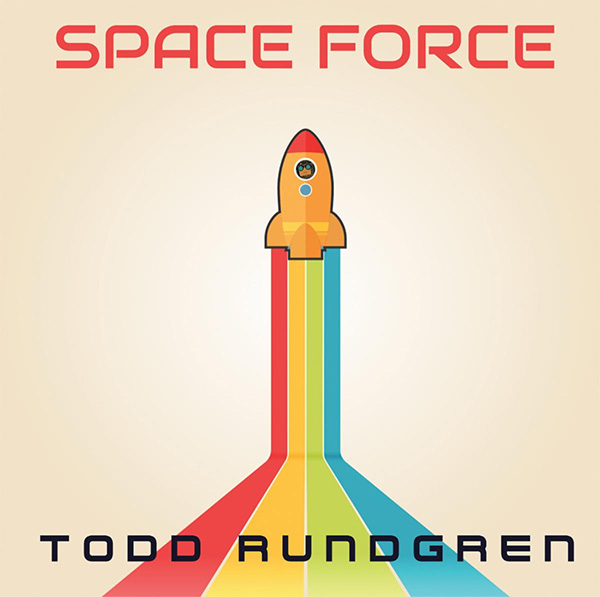
Rundgren: It affected me directly on the last record that I made, which was called Space Force. I got the record finished and was about to release it, but my label insisted on releasing all formats at once. In other words, they didn’t wanna release any electronic versions before the vinyl was ready. And just as we’re about to set a release date, Adele drops a surprise record [November 2021’s 30], and all of the vinyl in the world is gone. (chuckles)
So, it tacked almost another year onto the release date until there was enough vinyl for me to schedule a release, and I’m never doing that again. I’m never waiting for the vinyl! (laughs) [Space Force was finally released on multiple formats via Cleopatra in October 2022.]
Mettler: Speaking of Space Force, I do have to say that I love “Artist in Residence” (Side A, Track 3), the song you did with Neil Finn. That one’s just fantastic. It’s a really great piece, to my ear.
Rundgren: That was a great song — and principally his. You know, a lot of Space Force was sort of an evolution of [June 2017’s] White Knight, on which I started doing a lot of collaboration. I hadn’t done much collaboration before that, and that album was somewhat aggressively collaborative — but I wrote most all the material on it.
On occasion, I would have some co-writing — but on Space Force, I decided I would turn over more of the writing to other people. I asked whoever it is I collaborated with if they had a song they hadn’t finished that they might like to put some fresh ears on. I would listen to it and hear it in a little different way, and get the project restarted. That happened in a lot of cases.
Rundgren: It was the same thing with Sparks. They had the song “Your Fandango” (Side A, Track 5) pretty much all done but it wasn’t arranged, and there were some parts that I added to it. So, from that standpoint, it was probably more fully collaborative in that I let other people take more of the writing responsibility — and it turned out well in most cases, because a lot of people have great ideas that they never finish.
Mettler: What do you consider to be your priority as a producer when it comes to getting the right sound, or sounds, for a record?
Rundgren: I have a priority when I’m producing. The thing at the top is the song. Nobody wants to hear a great recording of a terrible song, so if you get a good song, you’re 90% of the way there. And if you perform it convincingly, you’re 99% of the way there. Most people, in the audience at large, the first time they hear something, they think that’s the way it’s supposed to sound — that’s what you meant for it to sound like, and that’s almost imprinted in there. They don’t think, “Oh, maybe there’s too much reverb on this.” They don’t analyze it that way.
If the song connects with them, and the act that’s performing it does it convincingly, then that’s pretty much everything. I mean, why is “Louie Louie” [specifically, The Kingsmen’s 1963 version of the Richard Berry-penned song] one of everybody’s Top 10 all-time records? (laughs) It’s in the Top 10 seminal records of all time — and nobody can understand the lyrics on it. It’s just a magnificent noise, or whatever it is.
Mettler: I agree that the song comes first, and then the songcraft comes next — and that includes how you produce it.
Rundgren: Well, songs just evolve naturally. Sometimes you just forget what you originally did and start accidentally substituting something else. But from a recording standpoint, I think it’s always better if the band has performed the material in front of an audience, because then they know when it works.
If you write something brand new and you come into the studio, you’re kinda feeling around it. You don’t know how an audience would respond to it because you’ve never done it in front of anyone, so it’s harder to find the “ideal” performance of it.
In the case where I’ve had a band perform the material in front of an audience before coming into the studio, the whole process is just so much more pleasant. First of all, most of the song issues have been worked out because they’ve been performing them, and then they feel comfortable with it. They know how to play it, so it works.
Mettler: Can you give me an example of that?
Rundgren: With a band like The Pursuit of Happiness — we did their first record [October 1988’s Love Junk on Chrysalis, which features the still-great alt-rock hit “I’m an Adult Now”] in like a week. We were taking it easy because, by the time we did the third take, it was as good as it was ever gonna be. (smiles)
Mettler: Well, here’s the last question before we gotta go now. What I like to do is throw us 50 years into the future. We’re in 2076, and, as I like to say, unless there’s some weird science going on, you and I may not physically be around then — but who knows? (scattered laughter) So, however people listen to music in that future timeframe, and they type “Todd Rundgren” or “Nazz” or “Utopia” into their listening device, what kind of experience do you want somebody to get from the music you’ve made?
Rundgren: Well, 50 years from now, God knows what contemporary music is gonna sound like! (both laugh) But I kinda consider myself an artist. Maybe I do that because it’s an excuse for why I don’t sell more records (chuckles), but for me, I’ve always had two gigs. I’ve had a production gig in which I market my skills to other people, and then there are my own records — and my own records are a product of what I’ve learned doing the other stuff.
I consider myself an artist in the sense that I’m not trying to calculate how the audience will respond to what I’m doing. I’m trying to figure out how to do something I haven’t done before — and then we’ll see how everybody responds to it. In that sense, if that particular aspect survives for 50 years, people may realize that this wasn’t simply meant to satisfy the audience of the time. It was an artistic experiment. Hopefully, it has value in that sense, because it’s never gonna be a hit again! (laughs)

Author bio: Mike Mettler is the editor of Analog Planet in addition to being the Sound Chaser columnist and contributing music editor to one of our other sister sites, Stereophile, in addition to being the regular Vinyl Icons column scribe (and occasional Opinion columnist) for Hi-Fi News, recently reinstated editor of Sound & Vision, and author of numerous box set liner notes. Plus, he’s quite partial to vintage 1967 Mustang fastbacks, but that’s yet another story for a different time.
















 |
Equipment Reviews | |
The Gruvy Awards | |
Blogs Analog Tips | Columns Music | |
Show Reports | |
News Resources |
 © 2026 AnalogPlanet
AVTech Media Americas Inc.
All rights reserved